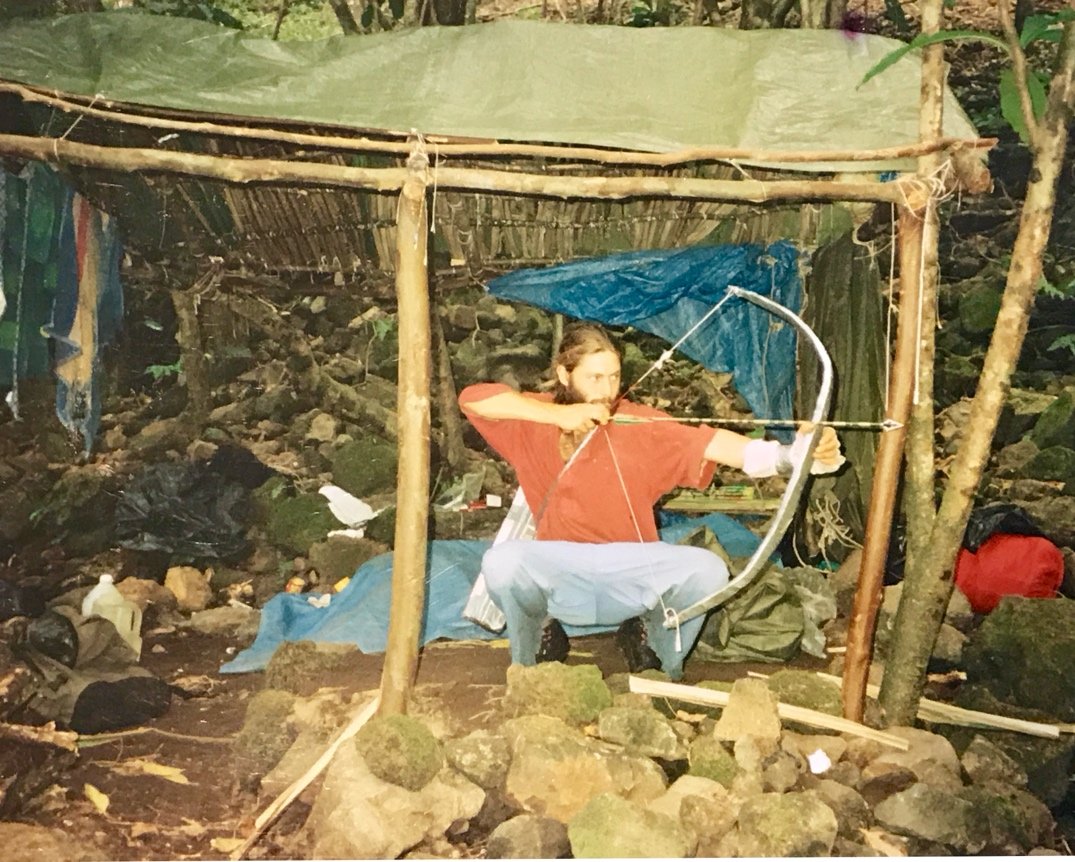
I’ve spent most of my career studying the science of sleep, consciousness, and the human mind. But some questions can’t be answered in a laboratory.
Waimanu Valley became the place where I began living those questions. Soul Search is what happened when science, nature, and lived experience finally became part of the same conversation.
The book
The Long Walk Home
Soul Search — expected publication date 2029. Illustrated with field photographs from Waimanu and accompanied by original music and a growing library of guided experiences on this site.
Chapters
Scroll to explore — both books
Excerpts
Begin where the journey began—or step into another corner of the story.
“Empty yourself of everything. Let the mind become still… The ten thousand things rise and fall while the Self watches their return.”
I woke to the sound of water, always water. It whispered through the ferns, surged through black rock arteries, slammed against sea walls, and flowed from the cliffs in a long exhale that never ended. The rain had rhythm. The river had tone. This place had a spirit you could feel the moment you stepped into it. In Waimanu, even silence had texture.
The jungle, alive with presence both seen and unseen, seemed to be staring back at me from behind the leaves. Somewhere in the distance, a bird shrieked once, then vanished into the canopy. I didn’t know it yet, but that sound would become my morning bell, my weathervane, even my omen. There, alone in the ancient heart of Hawai’i, I was not just removed from civilization. I was being unwound by something older than memory.
In the winter of 1993, I moved to Waimanu Valley to live alone in a primitive way. I was twenty-three years old and looking for a break from the monotony of college life. From a young age, my father had instilled in me a deep love of nature, and when I found Hawai’i, it felt like I had rediscovered a part of myself that had been waiting quietly all along. Once I tasted it, I wanted more.
I’m not talking about the hike up Diamond Head, though Waikiki is lovely if that’s your thing. I’m talking about a different Hawai’i. One that still echoes with old rhythms and feels closer to the ancestral. One that doesn’t perform for tourists but hums from a more primal place. That was the Hawai’i I craved.
Waimanu Valley is the second in a series of coastal canyons carved into the Kohala Mountains on the northeast corner of the Big Island. It is a place of extremes, delicate beauty alongside feral danger. The cliffs dominate the region like the spine of some primordial creature. It’s hard to imagine another place where a single valley holds six waterfalls, each dropping more than a thousand feet. Three miles inland, a 2,600-foot cascade thunders down from the cliffs above. Beyond it, the valley bends and narrows, stretching another mile and a half into mist and shadow, where more falls descend in veils of white.
The valley cuts more than four miles inland and opens to the sea in a half-mile-wide mouth, a rainforest trench carved by lava, guarded by vertical basalt walls and restless winds. Innovation hasn’t reached here. Time doesn’t march. It listens.
For a while, I believed I was Waimanu’s sole inhabitant. On occasional weekends, a few hikers would venture in, camping near the beach and taking short excursions before leaving again. But I lived deep in the back of the valley, beyond where most would think or dare to go. There were no trails to my hut, and few visitors ventured past the first major falls or river crossings. The interior belonged to me. My only reminders of the outside world were the helicopters that occasionally buzzed overhead, slicing the air like clock hands ticking in a different dimension.
Living alone in the jungle might sound romantic, but survival in this cloud forest came without a filter, a soundtrack, or a safety net. It remains the most demanding thing I have ever attempted. I was young, cocky, and painfully naïve about how hard it would be. It took only a few days for fantasy to give way to reality. Loneliness crept in like mist, thick and disorienting. The silence wasn’t empty. It was crowded with echoes of every doubt I had ever buried. That part, I had underestimated badly.
There were gifts, too. The kind only isolation can offer. Raw beauty. A sacred silence that sharpened the senses. A stillness that asked questions I hadn’t known I was avoiding.
Waimanu has a majestic black sand beach, a third of a mile long and, depending on the season and the mood of the sea, seventy-five to a hundred feet deep. In the wet months, the beach vanishes beneath the waves, returning each summer like a whispered secret. Just inland, a few campsites are marked by hand-stacked lava rock walls. Behind them, a grove of ironwood trees slopes down toward a freshwater pond fed by Waihilau Stream.
The valley’s center was a sprawling wetland, mossy and shimmering, difficult to navigate, bounded on both sides by cliffs that looked as though they had stood since the beginning of time. Standing at the pond near the beach, you could take in the sacred geometry of the place: the Pacific stretching endlessly eastward, the stream and pond behind you, and the great waterfall at the canyon’s headwall, wispy and flowing, like God speaking in tongues.
The ground was treacherous. Rockfall was constant, and the valley floor was often choked with rubble, lava shards, and loose stone that turned walking into an act of faith. In places, kukui nuts carpeted the jungle floor like marbles, transforming simple paths into cartoon scenes of slipping and flailing. Yet it was in this effort, in the daily work of moving from one place to another, that the forest began to change me.
About three and a half miles inland, past the largest falls, where the valley narrows and sunlight hesitates, I built my hut. Deep in the shade, where everything smelled of wet earth and time. I liked the remoteness, the view, and the gift of relatively dry ground.
So I called it home.
End of excerpt · Soul Search, Chapter 1
“The psychotic drowns in the same waters in which the mystic swims with delight.”
Growing up in the Midwest with Irish immigrant parents in the 1970s was anything but typical. To our neighbors, we were a curiosity. We lived in St. Joseph, Missouri, near the great Missouri River about thirty miles north of Kansas City. Directly across the street from our home on Frederick Avenue stood the massive psychiatric hospital where my father worked, an overcrowded two-thousand-bed institution that shaped more than a few of our family memories.
One summer afternoon, when all of us kids were home, the heat hung thick in the air. Missouri summers could be brutal, but to me they were magical. Our house sat beside corn and hay fields, alive with insects humming their humid chorus. I loved the sticky nights when lightning bugs took over the yard in bursts of gold. Even now, the sound of crickets and cicadas can pull me back into that sense of wonder.
That day, my siblings and I were playing out front when two figures dressed in white emerged from the tree line. One stumbled like a newborn deer. My mother rushed us inside, locked the house, and pulled the curtains, whispering urgently as if silence might make us invisible. The figures ran up and banged on the door. They were patients who had escaped from the hospital.
It was terrifying. I wondered if they would break in, if we were safe. Mom called hospital security, and eventually the pounding stopped.
This wasn’t a one-time event. I remember patients in hospital whites wandering across our lawn, almost dancing, and muttering, like a scene out of a strange, psychedelic children’s storybook.
Despite the madness across the street, our white farmhouse in the hayfield felt idyllic. We had my mother’s cooking, endless sibling antics, and my father as the ringleader of our chaos. We often piled into Dad’s Ford sedan and took off across the fields behind the house. The state provided housing for hospital physicians, and the neighborhood felt like a small United Nations. The Bartulicas from Czechoslovakia lived nearby, as did the Colemans from Austria.
All the doctors were immigrants, raising families in the middle of conservative, white, Christian Missouri. My best friend, Rizwan Ahad, lived across the street. His father was a Pakistani physician. On afternoons when we played, his mother would bring out warm naan with butter wrapped in a paper towel. I have never forgotten the taste. Simple, rich, and entirely exotic.
We took the Ford on wild rides down the circular driveway, one of my siblings at the wheel, none of us of legal age. We took turns driving, even me, the youngest, legs dangling far from the pedals. We shouted directions, laughed, even climbed onto the hood while the car rolled forward and Dad cheered us on. Looking back, it is a miracle no one was hurt. I am sure he was drinking. As a child, it felt like going to the carnival.
Life with five kids was already chaotic, but it tipped into something else entirely when my Aunt Maureen moved in with her five. Ten children under one roof. I was the youngest at two, Patrick the oldest at sixteen. It felt like living with a traveling football team. Wherever we went, we made a scene, and Dad, who loved attention, was always at the center of it. Aunt Maureen brought a new kind of energy. She was stunning, an incredible singer and actress who lit up every room.
Family dinners happened every night at six o’clock sharp and were anything but orderly. We drank so much milk that we used a commercial stainless-steel dining hall dispenser that held ten gallons. One night, my eldest sister Deirdre, who loved making people laugh, took a mouthful of milk, puffed out her cheeks, and pretended she was about to spray it across the table. The kids giggled. Then my sister Eileen snuck up behind her and slapped both cheeks at once, sending a perfect arc of milk flying through the air.
I sat there in awe, laughing. Nothing had ever seemed so rebellious. It felt magical. The incident sent Mom into a frenzy. I do not think it was the mess that upset her so much as the indecency of it all.
My mother carried a kind of English Protestant decorum that always seemed surprising, given her modest Dublin upbringing. Old-world manners ruled our house. Left-hand fork, right-hand knife. Soup spoons moved from front to back of the bowl. Never shovel. I can still hear her threatening that someone needed finishing school to learn proper table manners.
Whenever Mom got mad, she would threaten us with the wooden spoon. This so-called weapon took on the mythology of a fire-breathing dragon. As a small child, I imagined her unleashing it in a fit of wrath. Since the wrath never came, the legend only grew.
After some family incident sent her over the edge, she would suddenly declare, “I am getting the wooden spoon!” Sometimes it came as a warning, delivered in her most theatrical Dublin accent: “You don’t want me to get the wooden spoon, do you?” My favorite arrived with narrowed eyes: “I will use the wooden spoon if you are not careful.”
Then came the moment. She would dash to the drawer beside the sink, shouting, “You will be sorry.”
The kitchen erupted. There were four exits, each instantly filled with the fleeing shadow of a child. We all knew the threat was empty. I rarely even saw the spoon. But we loved the drama. There was screaming and laughter and just enough fear to make it thrilling.
Sometimes, in her attempt to intimidate us, she would slam the spoon against the counter and snap it clean in half.
Secretly, I always hoped it would break.
After dinner, Dad often gathered us to play poker. He loved teaching us, pouring coins from his jar and dealing hands like a Vegas table jockey. Somehow, someone always ended the night with an extra couple hundred bucks. In the 1970s, that caused a stir when a twelve-year-old went home unexpectedly rich.
Dad had his own brand of eccentricity. On St. Patrick’s Day, the O’Brien house came alive. We woke buzzing, waiting for the leprechaun to arrive, our Irish version of Santa. Dad even painted leprechauns on furniture, canoes, anything Mom would allow. On the 17th of March by midday, we’d hear coins hitting the front brick walkway.
Tink. Tink. Tink-tink-tink.
The leprechaun was dropping money from the roof from his pot of gold, always hidden by the house’s many roof angles.
We burst outside, grabbing dimes, nickels, and quarters mid-air. Sometimes a coin painfully smacked you in the face. Later came dollar bills. In later years, as Dad grew more successful, fives and tens appeared, and the scrambles got rowdier. Eventually, a paper airplane floated down with a note: Happy St. Patrick’s Day! — The Leprechaun.
We erupted every time.
It was one of my happiest family traditions, and it still lives on among my nieces and nephews’ families.
That night, every year the adults arrived in dress clothes. At the front of our home sat a sack of potatoes and a line of shovels. Dad’s admission fee was simple: plant a potato in the garden, rain or shine. Guests marched across the lawn, umbrellas in hand, digging before they were allowed inside. Potatoes surfaced in random places all summer.
Inside, Mom catered while Dad entertained. He sang Irish ballads as she mixed drinks and fed the crowd until they could not eat another bite.
Mom lived in the kitchen. I loved baking pies with her from the time I was three. She was the backbone of the family, teaching me about animals, geography, and people. With her, I felt safe. She was predictable, where Dad was a wild card. That steadiness mattered. Dinner at six o’clock was sacred, and in hindsight, one of the best parts of my childhood.
Over time, alcohol began chipping away at that foundation, especially at my parents’ bond.
I don’t want to exaggerate or soften it. My early years, up to about age six, were mostly good. But as my father’s drinking and health worsened, things unraveled. Like many children, I normalized the dysfunction. Before therapy, I never thought my childhood was strange. It was just mine.
There was love, and there was trauma. The two are not mutually exclusive. What scarred me was not one defining event but the slow accumulation of many painful ones: my father’s alcoholism, his chronic illness, his early death, my mother’s depression in the years that followed.
I wouldn’t have called it trauma then. But together, those forces set the emotional table for my life. Without realizing it, trauma stayed for dinner for decades.
I felt the dis-ease humming beneath the surface, but I couldn’t trace it to its source. Not yet. That would come later, with the fifth element. My own alcoholism.
I’ve come to believe the human spirit can be wounded. When those wounds go unhealed, they don’t simply fade. They surface in the body as illness, in the mind as despair, or in the heart as an ache that never stops whispering. Healing, I’ve learned, requires more than treating symptoms. It means returning to the source of imbalance and letting the body remember how to breathe again.
That understanding came much later.
The door clanged shut behind us, the sound echoing down a long, dim corridor—a locked ward, sealed off from the rest of the hospital. I pressed close to Dad as he strode ahead in his dark three-piece suit, the faint scent of his aftershave curling in the air, sharp and clean. He was the one thing that made this strange and lonely place feel safe.
The hospital was huge, a white fortress built in the late 1800s. Even as a boy, I could feel its age. The corridors seemed to breathe, holding secrets in their cracked plaster and arched windows. Voices echoed from unseen rooms. A patient shuffled past in threadbare slippers, muttering to himself. The air smelled of boiled cabbage and disinfectant, undercut by the bitter tang of cigarette smoke that clung to everything like a second skin.
We turned into the dayroom. Four men sat around a battered card table. They looked up as we entered, eyes tired, drained, faces lined by years of chain-smoking and bad coffee. Fingers discolored from nicotine twitched against the tabletop. A television blared a little too loudly. No one was watching.
“All right, lads,” Dad said, his Irish brogue filling the room, warm and steady. “You’ve room for one more at the table, haven’t you?”
One man nodded slowly. “Aye. Pull up a chair for the boy.”
Dad’s hand settled on my shoulder. “Go on now, Conor. Show them.”
I slid into the chair he held out, the metal cool beneath my hands. The men watched me with a silent weight in their gaze. Not unkind, but heavy, as if they were seeing through me to a part of me I didn’t yet know.
“What’s your name, lad?” one asked, with a low and rough tone.
“Conor,” I answered, my voice cracking.
“Well, Conor,” said another, his smile crooked and worn thin with yellowed front teeth, “hope you’re ready to lose.”
They chuckled softly, the sound dry and papery.
“How old are you?” the first man asked.
“Five,” I said, holding up my hand, fingers spread wide.
I set the deck of cards on the table and felt something.
Not a breeze, exactly. More like the room leaning in to listen.
I couldn’t explain it. I only knew the space felt different from the world outside those walls. Even there, Dad stood at the center of my universe, the captain of a ship carrying men whose lives rested in his hands.
Liam made bold changes in that place. Some were small but deeply symbolic. He ordered steak knives returned to patients so they could cut their beef like human beings instead of tearing it apart with their hands. For years, they’d been denied even that basic dignity. The act was simple, but the message was unmistakable: you are not forgotten.
He pushed for outpatient programs too, believing people could find their way back into the world beyond locked wards. In 1970s Midwestern America, that was a radical idea. State hospitals weren’t sanctuaries. They were warehouses where the unwanted quietly disappeared.
But perhaps his most remarkable achievement was creating a museum inside those walls. Working with occupational therapist George Glore, he founded the first psychiatric museum in the United States. It still stands today. Years later, one of the hospital buildings would be named the O’Brien Building in recognition of his work.
As a boy, I wandered through that museum behind my father, the lilt of his Irish accent echoing down the long hallways. The air felt different there—heavier, quieter, almost reverent. Behind glass sat iron restraints, ice baths, and the slender icepicks once slipped behind the eye during early lobotomies. The objects seemed almost alive in their stillness, as though they were keeping watch over the past.
The Glore Museum doesn’t flinch from our collective madness. It frames it and dares us to look. My father invited politicians and reporters to experience that history firsthand, even strapping Missouri Senator Thomas Eagleton into a cranked nineteenth-century “treatment” chair while cameras clicked. It was theater, certainly, but it was also a reckoning—a way of dragging the past into the light.
When I think of his legacy, though, I don’t picture the building that bears his name. I picture him handing steak knives back to patients, teaching hypnosis to his children by candlelight, and refusing to let people lose their dignity simply because they were ill.
Even then, I felt something in that place I couldn’t name—a faint shiver just beneath awareness. And I couldn’t have been prouder of the work he was doing there.
Looking back now, I think he was building a kind of shrine. Not only to the wounds of psychiatric institutions, but to the hidden wounds carried by all of us. Our own family did not live untouched by the shadows preserved behind those glass cases. We carried their echoes home.
Years later, when the boundary between waking life and dream began to thin for me, I found myself remembering that museum. How calmly the past sat on its shelves. How it bore witness without judgment. My father had found a way to give form to what most people refuse to see. He named it, displayed it, and invited the world to sit with its discomfort.
Perhaps, without realizing it, he was teaching me to do the same.
At home, he had a way of turning the ordinary into something quietly strange. He called it hypnosis, though to us it felt more like a family ritual disguised as play. After dinner, he would dim the lights, light a single candle, and set a pocket watch swinging from its chain. Back and forth. Its metallic glint caught the flame as he told us to listen closely to his voice.
His tone would drop, slipping almost to a whisper. He spoke to us about how our eyelids were growing heavy, that we were drifting into sleep, and that when we woke we would be in a trance. He spoke with a calm authority that made the room feel smaller.
I remember my head growing heavy, the watch blurring into candlelight, the edges of the room softening. The next thing I knew, his voice was calling me back. I opened my eyes, calm and clear. My siblings were smiling.
We talked for a moment. Then he casually removed his thick, dark-rimmed glasses. Having given me the post-hypnotic suggestion earlier that I should do the dishes when he did this, I stood and walked to the kitchen sink and began washing plates while everyone burst out laughing. It felt strangely peaceful, as if I were watching myself from a short distance away.
Long before I had words for it, I had already seen what trance could do. My father never explained it. He would just give that wide-eyed look, the one that seemed to say there’s more going on here than you think.
On another occasion, I woke with an excruciating pain in my neck. I was nine, maybe, and could barely move. After Tylenol didn’t help, my father suggested hypnosis. He guided me into sleep and told me that when I woke, the pain would be gone.
When I opened my eyes hours later, the stiffness remained, but the sharp pain had vanished. I could finally move again. It felt miraculous, or perhaps like belief made tangible through his voice.
Liam could be reckless with his gifts, but beneath the mischief he was deeply earnest. He had an impulse to ease suffering wherever he found it. I didn’t know it then, but an interest in me had awakened, too—a fascination with the thin threshold between mind and body, where words could reach pain and make it loosen its grip.
He was not a small man in any room. He could take a gathering in his hands the way a conductor takes an orchestra — with voice alone. Stories poured out of him, vivid and persuasive, delivered in that resonant baritone that made even the improbable sound inevitable. He drank and sang like he was auditioning for the Rat Pack; his singing could enrapture a room and push even the men to tears. He truly spent money as if abundance were a moral stance, and helped strangers with a generosity that bordered on reckless.
Once, determined to clear a branch himself, he carried a chainsaw onto the roof, fell three stories, hard, broke his back, and refused to go to the hospital. He lay black and blue for weeks, stubborn as stone. There was grandeur in him, and volatility. Charm and chaos braided together.
That same current ran through his curiosity about the mind. Hypnosis. Altered states. Leprechauns sketched in margins. He moved toward mystery the way he moved toward everything else — boldly, theatrically — and then, just as suddenly, he would pull back. Professional credibility reasserted itself. The edge remained the edge.
While sorting through old papers from my time in Hawai’i, I found a document I wasn’t expecting: my father’s psychiatric thesis from 1965, written for the Menninger School of Psychiatry. It was titled The Magic Whisp. I assumed it would be dry and clinical. I was a child the last time I had seen it. Instead, it shimmered with mythology. It read like a bridge between worlds.
End of excerpt · Soul Search, Chapter 15
About the author
Conor S. O’Brien is a scientist, musician, and lifelong explorer of consciousness. His career has been devoted to the science of sleep, while his personal journey has led him through wilderness, music, meditation, and the deeper landscapes of the mind. Soul Search: The Long Walk Home is where those two paths finally meet.
Conor O’Brien has spent his life following two paths that rarely meet.
One led into hospitals, research laboratories, and the science of sleep, where for more than twenty-five years he helped lead clinical research exploring human performance, circadian rhythms, and the mysteries of consciousness. He has worked alongside physicians, scientists, and health systems to build research programs that improve how medicine is practiced.
The other path led somewhere much quieter.
In his twenties, Conor left behind the familiar world to live alone for six months in Hawaiʻi’s remote Waimanu Valley. There were no roads, no electricity, and few distractions beyond the rhythm of the ocean, the rain, and the changing light. What began as an adventure gradually became an education in attention — one that continued long after he returned home.
Over the decades that followed, his search expanded through music, meditation, dreams, psychotherapy, altered states of consciousness, and thousands of hours spent asking a deceptively simple question: How do we become whole?
Rather than choosing between science and lived experience, Conor has spent his life allowing each to inform the other. His work is grounded in evidence, yet remains open to wonder. He believes curiosity is one of our greatest human capacities — not because it gives us certainty, but because it teaches us how to ask better questions.
Soul Search: The Long Walk Home is the meeting place of those two lives. It is a memoir, an exploration of consciousness, and an invitation to slow down long enough to notice what modern life often asks us to overlook.
Today, Conor continues to write, compose music, photograph the natural world, and return whenever he can to Waimanu Valley. Through his writing, talks, music, and immersive experiences, he hopes to encourage others to cultivate a deeper relationship with nature, themselves, and the enduring mystery of being alive.
He lives in Massachusetts with his wife, June, while always carrying a small part of the valley home with him.